
Quicksetts vs Traditional Granite Setts.
If you’ve ever had to choose the right paving for a traffic calming scheme, a heritage town centre, or a developer-led public realm project, then you’ll know the dilemma. On one hand you’ve got traditional granite setts – centuries of proven performance, undeniable charm, and a look that conservation officers just can’t get enough of. On the other, Quicksetts – surface mounted modules that promise the visual effect of natural stone but can be open to traffic in a few hours rather than waiting weeks for the traditional stuff. When it comes to delivering speed bumps, raised tables, and civic plazas on time and on budget, the choice is a no-brainer. This article breaks down the cost-benefit trade-offs across capital cost, installation time, disruption, whole-life value, appearance, maintenance, and sustainability – we want to help you make a decision that’ll give you confidence in your next project.
What Are Traditional Granite Setts UK? (And Why We Still Can’t Get Enough Of Them)
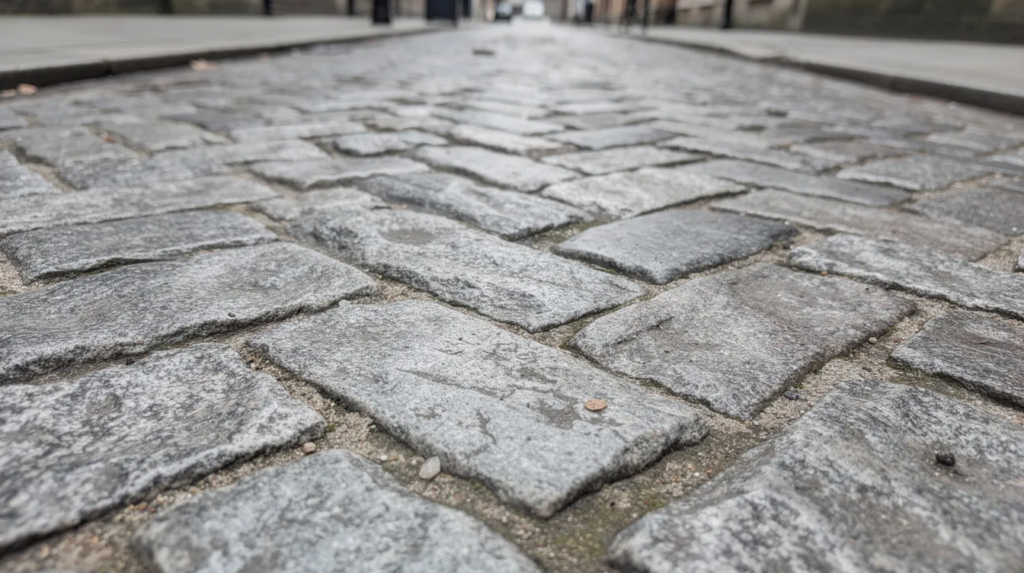
Granite setts are individual blocks of natural stone that have been paving UK carriageways, plazas, and driveways for centuries now. They’re an igneous rock that’s known for its durability and strength – that’s why they’ve been a go-to choice for so long. Granite is available in a variety of colours including grey, black, and pink, but it’s the silver and darker grey colours that are the most commonly specified for streetscapes. You’ll find sizes ranging from 100×100 mm cobblestones through to 200×100 mm setts, and depths from around 50 mm for lighter pedestrian areas up to 100 mm or more for full carriageway use. The finish really does make a difference – a flamed finish gives great slip resistance in wet conditions, a natural split finish gives a more rustic, cobbled look, and a bush-hammered finish has a smooth textured finish for better grip. And let’s not forget the sawn and tumbled finish which creates an aged appearance that’s perfect for heritage projects.
So why do specifiers keep coming back to them? Because granite setts can last over 50 years with minimal maintenance – in fact, many historic streets are still carrying traffic on surfaces laid in the Victorian era. That’s why they’re the perfect choice for civic and historic restoration projects in places like Bath and York – they’re virtually maintenance free. Plus, they last up to ten times longer than block paving and can withstand heavy vehicle traffic without cracking, thanks to a water absorption rate of less than 0.4% and the ability to withstand frost cycles and weather damage.
They’re a pretty versatile product too – granite setts are great for driveways that handle vehicle traffic, pathways and garden paths, patio edging, and even borders. They create distinctive courtyards and entrance aprons, visually striking borders between different landscaping elements, and are often used for steps and level changes for grip. Common laying patterns include herringbone and random coursing – so you can get that rustic or heritage look, or go for a clean and contemporary look – they really do complement both traditional and modern architecture.
The catch? They’re a bit of a pain to install. You’ll need to excavate, create a compacted MOT Type 1 sub-base (typically 150–250 mm), a cementitious bedding course, place each stone individually, and join with mortar. The construction depth and labour required are what drive programme length and cost upwards.
What Are Quicksetts? Surface-Mounted Setts for Fast-Track Projects
Quicksetts are pre-manufactured modular panels – usually concrete or resin-bound units with a granite sett or cobble face. They’re designed to be stuck directly onto existing asphalt or concrete surfaces – think of them as a surface-mounted overlay rather than a full reconstruction. Firms like Jobling Purser manufacture them, and they’re often used for raised tables, pedestrian crossings, gateways, mini-roundabouts, and traffic-calming features like road humps and speed bumps.
These panels come in modular formats with faux joints to mimic traditional setts while spreading load over a larger base. Installation uses specialist adhesives or bedding mortars onto a sound existing surface, and areas can often reopen to traffic within hours rather than weeks – that speed makes Quicksetts an attractive option for temporary or trial traffic-calming schemes, fast delivery on developer-led projects, or anywhere programme constraints make full excavation unviable. Despite the quicker installation, they are designed to withstand vehicular traffic – including at junctions and approaches to speed bumps.
Heritage Aesthetics vs Visual Realism:
Can Quicksetts Deliver The Same Effect?For people working close to conservation areas, the visual impact is a make or break factor. The real deal with traditional granite setts is that they are genuinely three-dimensional with tiny variations in colour and texture that come from the stone’s very nature. Maybe you go for ethically sourced silver grey with a natural split finish, or a darker grey granite cobble – either way, you get a surface that develops a nice patina over time and looks dead authentic from a distance.
Quicksetts, by contrast, deliver neat, consistent joint widths and alignment. From the rush of a moving vehicle at 20-30 mph, a well-specified Quicksett raised table can actually be quite convincing. Up close, though, the profiles tend to look a bit flat and uniform – less of that 3D texture you get with individually hand-laid cobbles.
Where do each work best? Traditional setts are a no-brainer for areas where pedestrians are going to be giving them a close look: cathedral precincts, heritage railway stations and civic plazas. Quicksetts are more sensible for functional traffic-calming on a B-road or bus lane, where you just need visual contrast and compliance rather than museum-grade authenticity. A council might be happy with Quicksetts for a raised crossing on a suburban road but say “no way” to genuine granite for the market square next to it – and that’s a perfectly rational split.
Programme and Disruption: Weeks vs Hours on Site
This usually decides the question on live carriageways, so let’s break it down step by step. Imagine a 50-metre raised crossing with traffic-calming road humps at the ends.
With traditional granite setts the typical sequence goes something like this: set up traffic management, close the road; dig up to 200-300 mm, remove the spoil; install sub-base and compact it in layers; lay the bed and individual setts ; do the jointing and pointing; give it time to set; adjust the kerb and finish the edges. Realistically, you’re looking at two to three weeks of disruption, with phased closures and diversions hitting buses, emergency services and local traders.
With Quicksetts on the same crossing, the programme is cut right back. Lightly mill or clean the existing asphalt, lay out the modules, bond them in, seal the edges and you’re usually done in an overnight possession. You could close a B-road on a Friday night, slap in a full Quicksett speed table and have it re-open to traffic by Saturday morning. The same job in genuine granite might mean a partial closure from Monday through to the end of the following week.
This really benefits all the stakeholders. Councils take less flak from traders and residents waiting for access. Developers reduce the risk of blowouts and getting slugged with liquidated damages. Bus operators and emergency services can keep their regular routes. On many live carriageways, the programme risk is just as important as the paving material cost.
Upfront Cost Comparison: Materials, Labour, Traffic Management
“Cost” for specifiers is more than what’s on the supplier website. It’s the price of the materials plus labour plus traffic management, and it’s all a question of which system you are using.
Traditional granite setts typically cost between £35 and £65 per m² for just the materials, depending on size, finish and colour. You can get silver grey flamed finishes for around £55.45 per m² and edging stones can cost you from £27.16 per linear metre. But you can get granite setts in 1 tonne crates starting at £359.00 and delivery on full pallets is free on the UK mainland. But it’s just the materials that are part of the story – labour for laying each stone and doing the jointing can add £50 to £80 per m² for simple layouts and up to £120 per m² for complex patterns. And then there are the groundworks and sub-base preparation costs of £20 to £40 per m², and don’t forget traffic management – that can easily cost £5,000 to £10,000 depending on how complex the diversions are. Overall, fully installed traditional granite can end up costing £100 to £160 per m².
Quicksetts have a higher apparent price per m² for the prefabricated units, but labour hours plummet – you are placing panels rather than thousands of individual stones. You don’t have to dig up much or any of the existing pavement, and traffic management time is cut right back to overnight or single-weekend closures, which slashes cone, light and diversion costs significantly.
To put it in context, imagine a 200 m² traffic-calming scheme with bump strips and gateway features. In traditional setts, the total installed cost might come in at £35,000 to £40,000. The same area in Quicksetts might come in at £25,000 to £30,000, with the saving driven almost entirely by labour and traffic management rather than materials. In many live-road jobs, Quicksetts can actually come in cheaper overall despite being higher unit price.> Assume all Figures are approximate 2020s UK market ranges. Always price up your specific scheme with current supplier quotes and think about all the other costs that’ll pile on in real life.
Whole-Life Value: Silver Grey Durability, Maintenance & Repair Strategies
The conversation shifts from “What will it cost us just this year” to “How will this surface do over the next 10-25 years?” – and that’s when business cases really get won or lost.
Granite setts have a proven track record for being pretty reliable for over a century. Most of the time it’s the base or foundation that fails, not the stone itself, and sorting that out is a relatively straightforward job: lift the cracked or broken stones, re-lay and re-bed. And because you can reuse the individual stones over and over, granite has a big advantage when it comes to getting rid of waste and doing your bit for the circular economy. Maintenance is pretty rare – just a bit of re-pointing every decade or so, a bit of weed control in the joints – and because it’s so tough, you can be pretty confident that the surface won’t start to crumble or degrade within your working lifetime.
Quicksetts, on the other hand, rely more on the quality of the base underneath. Realistically, you’re looking at a lifespan of around 10-20 years, especially if its getting heavy traffic. The main risks are that the adhesive will fail, the edges will start to come loose and there will be problems if the asphalt underneath starts to crack and shift. On the plus side, its not that hard to replace individual modules, especially if the layout needs to change later down the line.
If you’re planning something that needs to last 30 years or more, then traditional granite is probably the way to go. If you’re working on a 20 mph zone that might change over the next decade then Quicksetts might be the better bet, even if it means you get a slightly lower upfront cost.
User Experience: Ride Quality, Noise & Compliance with Traffic-Calming Guidance
When it comes to features like speed bumps, humps and raised tables, engineers have to try to balance slowing down traffic with making sure people aren’t too uncomfortable while they’re driving. The Highways (Road Humps) Regulations 1999 say that humps have to be between 25mm and 100mm high, at least 900mm long and with a standard height of 75mm – this slows down traffic to around 22mph without being too much of a shock. Unfortunately, traditional granite setts can make a bit more noise as the tyres go over them, which can be a problem for residents in nearby houses. Quicksetts, on the other hand, are a bit smoother and have more consistent ramp geometry, which makes them useful when you have to comply with LTN 1/20 limits (that’s a max gradient of around 12.5% for cyclist safety) across lots of different sites.
In practice, most councils tend to use Quicksetts where they’re right next to residential properties and reserve granite setts for civic squares where car speeds are already pretty low and noise isn’t so much of an issue.
Environmental and Ethically Sourced Considerations
These days specifiers are not just thinking about how much it costs and how it looks – they’re also thinking about the carbon footprint, the sourcing and the companies they’re working with. Traditional granite setts can travel a long way to get to site – from quarries in Portugal, India or China – and have a big carbon impact because of all the extraction and shipping that goes into them. However, because they last for such a long time and can be reused, they have some good credentials when it comes to the circular economy. It’s pretty standard practice these days to make sure that any granite you’re using is sourced from companies that are doing things properly.
Quicksetts are usually made a bit closer to site, which can cut down on shipping emissions, but they do have their own carbon footprint because of all the materials that go into making them – concrete, resins and adhesives. On the other hand, they can cut down on excavation because you don’t have to dig up the road structure – that can cut down on plant hours, spoil haulage and emissions from detours.
In the end, neither option is going to be a complete winner when it comes to being green. We’d encourage specifiers to ask for Environmental Product Declarations (EPDs) for both and to remember that when it comes to heritage level authenticity, you might be able to make a bit of a compromise and go for a Quicksett solution on an existing asphalt base – it might be a bit less flashy but it might also be a bit more environmentally-friendly.
Practical Specification Tips: How to Buy Granite Setts and Choose the Right System for Your Scheme
Most specifiers have to work with a bit of compromise rather than a perfect solution, so here’s a quick guide:
- Go for traditional granite setts if appearance is everything, the lifespan is going to be 25 years or more, and you can live with the road closures.
- Go for Quicksetts if you want to try out some new traffic calming layouts on the fly, or you need to do it all with minimal disruption and on a tight budget.
Before you decide on Quicksetts, make sure you’ve checked the structural integrity of the existing asphalt or concrete – if that’s failing then surface-mounting isn’t going to save you. For traditional setts, check that the sub-base is up to scratch for the expected axle loads, especially if its a busy bus road. Both systems can be used for compliant speed bumps and humps or bump strips if you follow the DfT guidance and local authority manuals.
Consider trying out a pilot section first – a single raised table in Quicksetts can get you some feedback from local residents and help get the design sorted before you go full-on.When looking to source materials, keep in mind that there are quite a few UK suppliers that cater to a variety of project sizes and quantities. Granite Setts UK, for instance, will send you a free sample of their granite products and they offer delivery services right across the UK. Universal Paving is another company that stocks granite setts for fast UK delivery, while Granite Setts Direct aim to deliver your order within 2 to 3 working days. Shop Granite Setts will even match their competitor’s prices, which is a nice perk. On the other hand, Marshalls won’t be able to deliver to anywhere outside of the UK mainland.
Now, when you’re browsing a supplier website looking to buy granite setts, you may well come across a page that needs you to do a security check – this is just the site’s security service keeping an eye out for any malicious bots trying to break in. If you see a message saying something like “respond to this ray id” or “your verification has been successful”, that’s perfectly normal. It’s just making sure you’re not a bot and then the site will load up shortly. Don’t let the brief wait get in the way of adding items to your basket – I know it’s frustrating but just be patient.
Also be aware that the amount of ground you need to cover will depend on the size and weight of the packs you’re ordering, as well as the pattern you’re going for. Because of this many suppliers display their stock levels, the price including VAT, and the pack details on the product page so you can easily check the quantities you need before you go and place an order.
When Quicksetts are the winner and when Granite Setts are the way to go
Rather than traditional “case studies”, we have two real-life scenarios that you may well have come across yourself in your project pipeline.
Scenario 1 – Urban 20 mph Zone Retrofit: A UK local authority wants to fit eight raised tables and speed bumps in a Victorian suburb. Existing roads are in a good state of repair and are made of asphalt. Shops line the road on either side. The team use Quickset modules to complete all eight features over a series of overnight possessions – no daytime road closures, no bus diversions needed. Total project time: three weekends. In contrast, an earlier, traditionally settled scheme elsewhere in the borough had taken five weeks and caused a lot of complaints. The Quicksetts delivered an affordable and suitable solution that kept the community on side.
Scenario 2 – Historic Market Square Renewal: A town centre in a conservation area. The planners are being very particular and insisting on genuine silver grey granite setts and cobbles, with natural split and tumbled finishes, to match the surviving 19th-century surfaces. The project requires a full road closure for several weeks, deep excavation, and skilled masons. Result: a surface that should last 50+ years, can support heavy delivery vehicles, and has created a lovely garden-like setting around the war memorial. Plus, it’s already given a boost to civic pride and footfall. External paving of this quality is a long-term investment in place-making that really pays dividends for generations.
The takeaway is that most authorities will end up using a mix of both – Quicksetts for quick tactical interventions on the road network, and traditional granite for flagship spaces where performance, texture and heritage character justifies the investment.
Balancing budget, programme and Place-Making
Traditional granite setts remain unbeaten where you want authenticity and a long life – that’s where you reach for them when you need a surface that will last for 100 years plus, when the conservation officers are watching and when the surface itself is part of the story. Quicksetts on the other hand excel where rapid installation, lower disruption and manageable upfront budgets dominate the brief – especially for traffic-calming features on live carriageways where every extra day of closure costs goodwill as well as money.
The smartest specifiers think in terms of “the right material for the right job” rather than assuming one solution should be used for every project. Review your current traffic-calming and public realm pipeline. Identify where switching to Quicksetts could save you weeks of disruption – and where upgrading to true granite could unlock a step-chance in place quality. With a clear view of the benefits, you can confidently defend your choices to councillors, planners and the public knowing that every metre of paving is earning its keep.