
A bare slope loses soil with every storm. Rain detaches particles, runoff carries them downhill, and the channel below fills with sediment. Turf breaks that sequence by covering the surface with living, anchored material before the next rain arrives.
The word “turf” confuses me, so define it first. We cover vegetated turf and sod, meaning grass grown on a soil base, which is the form civil and landscape projects use for slope and channel protection. Synthetic turf behaves differently and appears only where noted.
The stakes are practical. A slope that keeps shedding soil undercuts foundations, blocks drains, breaches sediment regulations, and forces repeated repair bills. Installed correctly, turf reduces erosion and supports drainage through three mechanisms: root reinforcement, runoff reduction, and infiltration. It does this within limits that this article makes explicit, because turf fails in the wrong setting.
How turf controls erosion
Root reinforcement and soil cohesion
Grass roots bind soil particles into a fibrous mat that resists detachment. This added cohesion raises the soil’s resistance to the shear force that flowing water applies. A denser root network makes it harder for water to lift and carry particles away.
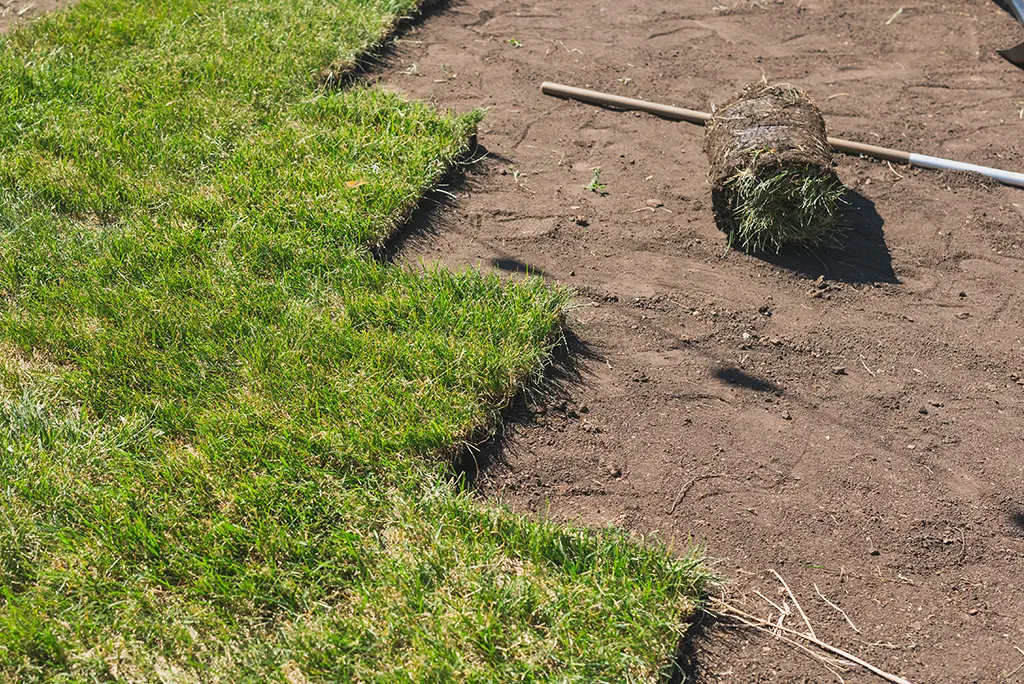
Roots also hold the top few centimeters together during the first impact of rainfall. That surface layer is where most detachment starts, so protecting it cuts erosion at the source. A continuous sod layer delivers this protection on day one, while seed needs weeks to reach the same root density.
Canopy interception and slower runoff
Grass blades intercept raindrops and break their kinetic energy before they strike the soil. Lower impact energy means fewer particles knocked loose. The blades also increase surface roughness, which slows overland flow and gives water more time to soak in.
Field measurements back this up. One rainfall-runoff study found that vegetative cover cut soil erosion by 44 percent against bare control plots. Slower, shallower flow carries far less sediment, which is the outcome every drainage system downstream depends on.
How turf improves drainage
Infiltration through a living profile
Healthy turf builds soil structure over time. Roots open channels, and the organic matter they add improves porosity, so more rainfall enters the ground instead of running across it. Higher infiltration lowers the peak volume that gutters, swales, and pipes must carry.
This matters most at the top of a catchment. Every liter that infiltrates on the slope is a liter the drainage network never has to move. Turf therefore acts as a distributed, low-cost first stage of stormwater management.
Controlling surface water without ponding
Turf works alongside engineered drainage rather than replacing it. Designers route concentrated flow into grassed swales, where the vegetation slows water and filters sediment on the way to an outlet. A permeable base under the turf prevents the waterlogging that kills grass and defeats the purpose.
The pairing is deliberate. Turf handles diffuse sheet flow and infiltration, while catch basins, channel drains, and French drains move the concentrated flow that turf alone cannot. Together, they keep water moving without ponding or scour.
Turf compared with other erosion control methods
The right choice depends on flow conditions, budget, and how fast you need cover. The table sets out the common options side by side.
| Method | Erosion protection | Drainage effect | Establishment time | Relative cost | Best use |
| Sod / vegetated turf | High once rooted | Improves infiltration | Immediate cover, full root in weeks | Low to moderate | Mild to moderate slopes, lawns, swales |
| Hydroseeding | Moderate, grows in | Improves infiltration | Several weeks | Low | Large areas, gentler grades |
| Turf reinforcement mat (TRM) | High, including high flow | Permeable, supports vegetation | Immediate, full at 6 to 12 months | Moderate | Steep slopes, channels, ditches |
| Riprap (hard armor) | Very high | Drains freely, no infiltration gain | Immediate | High | Extreme velocity, scour zones |
| Bare soil with silt fence | Low, temporary only | None | Immediate but short-lived | Low | Short-term construction control |
Plain turf wins on cost and drainage benefit for ordinary slopes. High-velocity channels need reinforcement or hard armor, which the next section covers.
When plain turf is not enough: turf reinforcement mats
What a TRM adds
A turf reinforcement mat is a permanent three-dimensional structure laid on the soil. Grass grows up through it, and the mat anchors the roots so the combined system resists far higher flow than grass alone. A TRM gives some protection immediately and reaches full strength once vegetation establishes.
These mats suit drainage channels, steep embankments, and pipe outfalls where unreinforced grass would wash out. They keep the infiltration and appearance of vegetation while tolerating the shear stress of concentrated flow.
Soft armor versus hard armor
Engineers choose between soft armor (vegetation and TRMs) and hard armor (riprap or concrete block mats) using permissible velocity and shear stress. Vegetated TRMs handle moderate to high flows at lower cost and weight than rock. Where velocity is extreme or vegetation cannot survive, hard armor stays the safer choice.
The trade-off is clear. Soft armor costs less, looks better, and aids infiltration, while hard armor protects in conditions that would destroy any plant. The design flow decides which side of that line a site falls on.
Installation factors that decide success
Site preparation and grading
Turf only performs on a base that sheds water at a controlled grade. Loose fill, compacted clay, or an uneven surface causes ponding and root failure. Correct grading, a permeable base layer, and firm soil contact under the sod set up everything that follows.
Skipping site prep is the most common reason a turf job fails early. Water finds the low spot, sits there, and rots the roots before they anchor. A turf supplier that grades and lays the sod as one job, such as A View Turf, closes the handoff where most of these mistakes start.
Establishment window and maintenance
The first six to twelve months decide long-term performance. New turf needs steady moisture, protection from concentrated flow, and time to root before it faces a major storm. Mowing, reseeding of bare patches, and clearing silt from swales keep the system working for years.
Where turf fails
Turf is not a universal fix, and treating it as one invites failure. It cannot survive constant submersion, very high velocity flow, or deep shade with no growth. On unstable subsoil or on slopes steeper than the grass can hold, it slides as a mat unless deeper stabilization supports it.
Naming these limits protects both the site and your credibility. Match turf to diffuse flow and moderate grades, add a TRM for channels and steep banks, and reserve hard armor for the extremes. The right tool in the right place is what makes the slope hold.
Protecting Your Property with Turf
Properly installed turf controls erosion and improves drainage by anchoring soil with roots, slowing runoff, and raising infiltration. It delivers this at low cost on moderate slopes, scales up with turf reinforcement mats for channels, and gives way to hard armor only at the extremes of flow.