
You often associate linear stages with manufacturing labs or semiconductor facilities. In civil engineering, their role seems less obvious at first glance. Projects in this field deal with large structures, heavy materials, and field conditions that appear far removed from precision motion systems.
Still, many critical evaluations happen in controlled environments where accuracy defines the quality of your results. When you require micrometer-level positioning or consistent, repeatable displacement, manual adjustments fall short. Linear stages provide steady, measurable motion that strengthens experimental reliability and improves data integrity.
Their contribution extends further than expected, shaping how you measure performance, detect early weaknesses, and refine structural behavior. Read on to see how linear stages support civil engineering work in ways you might not anticipate.
Precision Load Simulation and Structural Component Testing
Civil structures face settlement, fatigue, and localized movement over time. You need controlled laboratory setups to study how individual components respond before they are installed in the field. Linear stages provide the measured displacement required for accurate simulation.
To replicate structural movement with precision, focus on the following applications:
- Incremental displacement application: You introduce controlled linear travel in small, predefined increments to simulate settlement or strain. This approach allows you to observe stiffness changes, load redistribution, and early deformation behavior without shock loading that could distort results.
- Micro-movement fatigue testing: You subject anchors, bolts, and connectors to repeated low-amplitude motion that reflects long-term service conditions. This setup helps you assess wear patterns, joint loosening, and performance degradation under cyclic displacement rather than static force alone.
- Instrumentation calibration: You apply known travel distances to verify the accuracy of displacement sensors, extensometers, and LVDTs. Consistent motion input ensures that measurement devices produce reliable readings before full-scale structural evaluation begins.
Many advanced laboratories collaborate with specialized manufacturers to meet strict motion accuracy requirements. When you source a linear motion stage from a manufacturer of high-precision motion control equipment, you gain verified positioning tolerances and repeatable travel performance. That technical assurance strengthens your experimental setup and supports dependable load simulation data.
Concrete Curing and Material Testing Applications
Concrete properties shift during hydration and early-age hardening. You need controlled measurement to capture those changes with accuracy. Linear stages support stable positioning and measured displacement throughout laboratory evaluation.
For accurate curing and material assessment, the following applications are especially relevant:
- Controlled compression displacement: During compressive strength testing, you regulate platen travel with fine positional resolution. This allows you to observe stress–strain behavior, elastic limits, and post-peak response with clearer deformation tracking. Precise movement control reduces alignment errors and improves the consistency of recorded results across multiple specimens.
- Shrinkage and creep monitoring: Long-term studies require consistent gauge placement as concrete undergoes time-dependent deformation. Linear stages reposition displacement sensors in small increments to follow gradual dimensional changes. This setup improves measurement continuity during extended observation periods.
- Repeatable sample alignment: When placing specimens under strain gauges or non-contact measurement devices, consistent positioning matters. Linear stages ensure each test begins from the same reference point, limiting setup variation and improving comparability between batches.
Accurate positioning during curing studies strengthens your understanding of material behavior and supports better-informed structural design decisions.
Crack Detection and Structural Health Monitoring
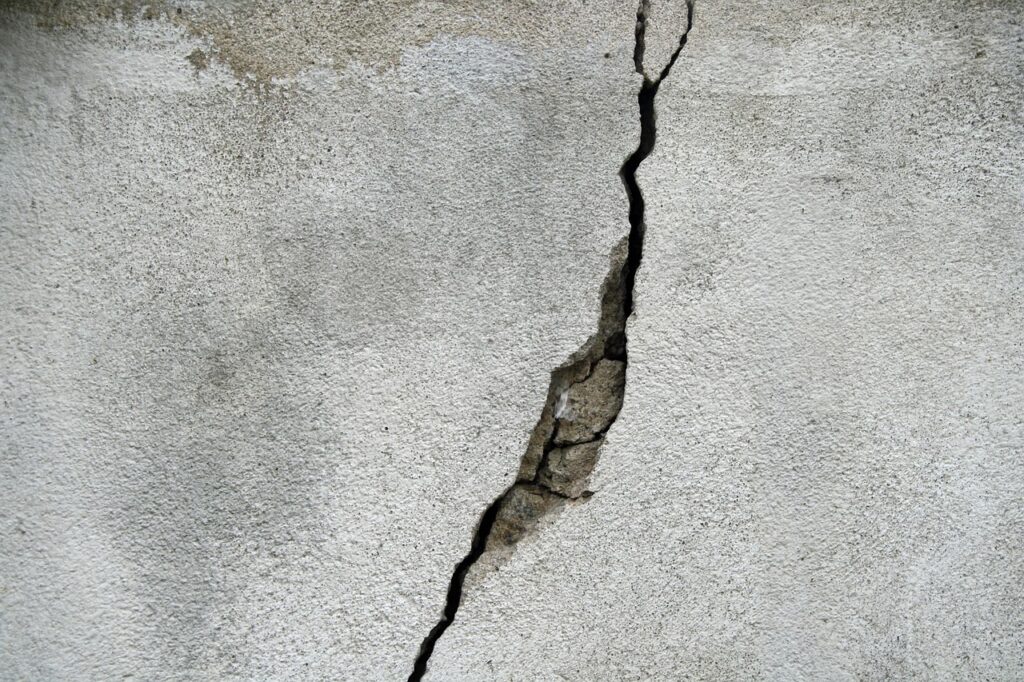
Surface cracks often begin as fine separations that are difficult to quantify with the naked eye. Accurate measurement determines whether they remain cosmetic or indicate structural distress. Linear stages support controlled, repeatable scanning that improves the reliability of recorded observations.
To start, high-resolution cameras mounted on linear stages move across concrete or steel surfaces in fixed increments. This controlled travel produces consistent image spacing and minimizes variation between inspection sessions. As a result, you can measure crack width and length with greater confidence.
In addition, repeat inspections require precise repositioning at the same coordinates over time. Automated linear motion allows you to return to predefined reference points without relying on manual markings alone. This consistency strengthens long-term monitoring and makes progression trends easier to interpret.
During load testing, structural elements such as beams and slabs develop measurable deflection and surface strain. Linear stages position displacement sensors with fine adjustment, ensuring accurate readings as loading conditions change.
Advanced Research and Smart Infrastructure Development
Modern infrastructure increasingly relies on precise measurements and automated systems to guide design and maintenance decisions. Linear stages provide the controlled movement necessary for laboratory experiments that examine material behavior under complex conditions. This accuracy allows engineers to collect high-quality data while minimizing setup variability, which can directly inform decisions in a construction project.
For instance, when testing sensor-embedded concrete or other smart materials, precise alignment of measurement tools is essential. Linear stages position sensors consistently, ensuring that calibration remains accurate across multiple tests. Consequently, research results reflect true material responses rather than inconsistencies caused by manual adjustments.
Additionally, controlled vibration and micro-movement studies benefit from gradual, repeatable motion introduced by linear stages. These systems can simulate the effects of wind, traffic, or machinery loads on prototypes, revealing performance characteristics before field deployment. The repeatable motion ensures that results are comparable over time and between experiments.
Final Thoughts
Linear stages rarely stand out in civil engineering discussions. Still, they quietly support critical testing, inspection, and research tasks. You use them to control displacement during curing studies, scan developing cracks with precision, simulate structural movement, and refine smart infrastructure experiments. Their value lies in repeatability, stability, and measurable motion.